Hemi Shoulder Replacement
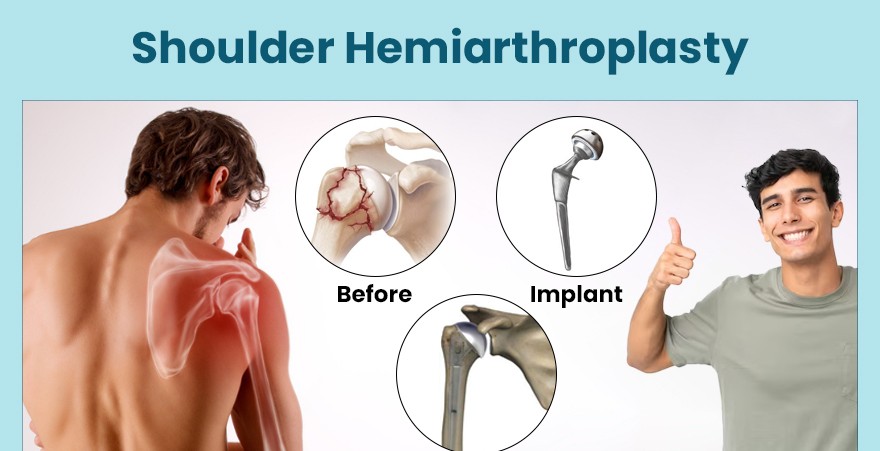
Hemi Shoulder Replacement, also known as Shoulder Hemiarthroplasty, is a specialized orthopedic procedure designed to relieve shoulder pain and restore mobility by replacing only the damaged ball portion of the shoulder joint. Unlike total shoulder replacement, the socket portion of the joint is preserved, making this procedure suitable for specific shoulder conditions where the socket remains healthy.
For patients experiencing severe shoulder pain due to fractures, arthritis, or avascular necrosis, hemi shoulder replacement can provide significant pain relief and improved shoulder function.
What is Hemi Shoulder Replacement?
Hemi Shoulder Replacement is a surgical procedure in which the damaged humeral head (the ball of the shoulder joint) is removed and replaced with a prosthetic implant, while the natural socket (glenoid) is left intact.
The shoulder is a ball-and-socket joint that allows a wide range of motion. When the humeral head becomes severely damaged due to injury or disease, replacing only the affected portion of the joint can help restore comfort and movement.
Who Needs Hemi Shoulder Replacement?
Hemi shoulder replacement may be recommended for patients experiencing:
- Severe shoulder pain that interferes with daily activities
- Complex fractures of the upper arm bone (proximal humerus)
- Avascular necrosis of the humeral head
- Early-stage shoulder arthritis with a healthy socket
- Shoulder joint damage following trauma
- Loss of shoulder mobility and function
- Failure of non-surgical treatments such as medications and physiotherapy
Conditions Treated with Hemi Shoulder Replacement
- Proximal Humerus Fractures
Severe fractures involving the upper portion of the arm bone that cannot be repaired effectively with fixation techniques. - Avascular Necrosis (AVN)
A condition in which the blood supply to the humeral head is disrupted, leading to bone collapse and joint damage. - Shoulder Osteoarthritis
Selected cases of arthritis where the socket cartilage remains relatively healthy. - Post-Traumatic Arthritis
Joint degeneration that develops after a significant shoulder injury. - Shoulder Joint Damage
Irreversible damage to the humeral head resulting from injury or degenerative conditions.
Benefits of Hemi Shoulder Replacement
- Effective Pain Relief
Reduces chronic shoulder pain caused by damaged bone and joint surfaces. - Preservation of Natural Anatomy
Retains the patient's natural shoulder socket whenever possible. - Improved Shoulder Function
Helps restore movement and everyday shoulder use. - Enhanced Quality of Life
Allows patients to return to many daily activities with greater comfort. - Less Extensive Surgery
In some cases, replacing only the humeral head may preserve more natural bone. - Durable Results
Modern prosthetic implants are designed for long-term performance and reliability.
The Hemi Shoulder Replacement Procedure
Preoperative Assessment
Before surgery, patients undergo a detailed evaluation that may include:
- Medical history review
- Physical examination
- X-rays
- CT scan or MRI
- Blood investigations
- Anesthesia assessment
Surgical Procedure
- The patient receives anesthesia.
- A surgical incision is made over the shoulder.
- The damaged humeral head is carefully removed.
- The upper arm bone is prepared for implant placement.
- A prosthetic humeral component is inserted.
- Joint stability and movement are assessed.
- The incision is closed, and recovery begins.
The procedure generally takes between 1 and 2 hours, depending on the complexity of the condition.
Recovery After Hemi Shoulder Replacement
Immediate Recovery
- The arm is supported in a sling.
- Pain management helps improve comfort.
- Gentle shoulder exercises may begin shortly after surgery.
Rehabilitation Phase
- Physiotherapy is essential for optimal recovery.
- Exercises focus on improving flexibility, strength, and range of motion.
- Daily activities are gradually resumed under medical guidance.
Long-Term Recovery
Most patients experience progressive improvement over several months. Full recovery may take 3 to 6 months, depending on the underlying condition and rehabilitation progress.
Risks and Complications
Like all surgical procedures, hemi shoulder replacement carries certain risks, including:
- Infection
- Blood clots
- Nerve injury
- Implant loosening
- Joint stiffness
- Persistent pain
- Shoulder instability
- Fracture around the implant
- Need for future revision surgery
An experienced orthopedic surgeon carefully plans and performs the procedure to minimize these risks.
Why Choose Hemi Shoulder Replacement?
Hemi shoulder replacement may be the ideal solution for selected patients because it offers:
- Reliable pain relief
- Preservation of the natural shoulder socket
- Improved shoulder movement
- Effective treatment for complex fractures
- Reduced joint damage symptoms
- Long-term functional improvement
When appropriately indicated, hemi shoulder replacement can provide excellent outcomes and restore quality of life.